The Coding Interview Changed. Algorithm Recall Is Out, Live AI-Pairing Is In.
Junior coding jobs didn't just get scarcer — the interview for the jobs left standing changed shape. Real data on the hiring collapse, and what Meta, Canva, and Google are actually testing for when they hand a candidate an AI assistant instead of a blank editor.
Senior and staff candidates are walking into loops right now that don't open with a blank editor and "reverse this linked list." They open with a real, messy feature brief and an AI assistant switched on — and the interviewer is watching how the candidate steers it, not whether they can recite an algorithm from memory.
This isn't a rumor or a single company's experiment. It's a documented shift across some of the largest engineering employers, running alongside a second, harder trend: the entry-level rung of the job itself is disappearing.
AI didn't just make hiring slower. It reset who gets hired at all
Start with the part nobody argues about anymore: junior hiring collapsed.
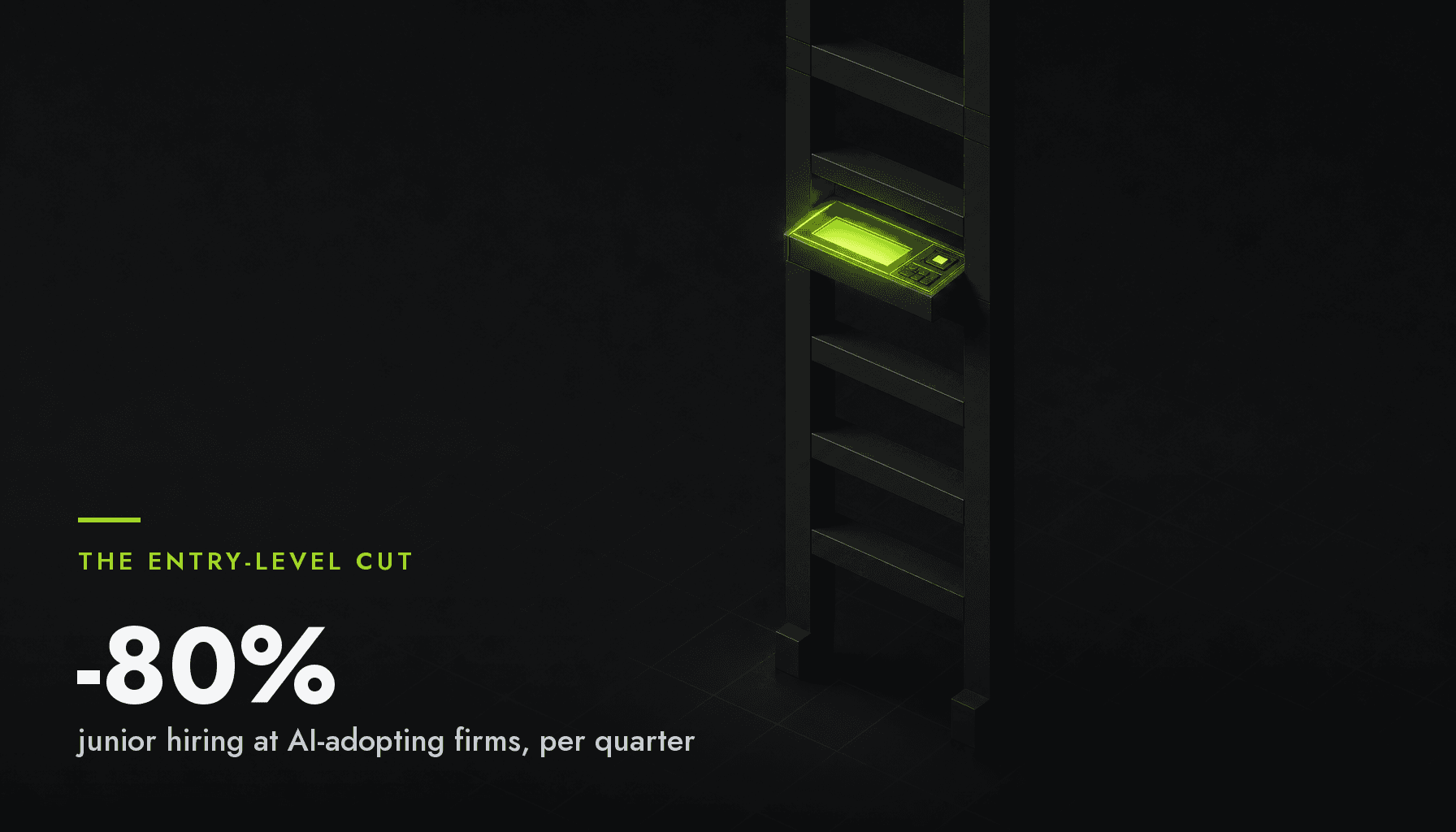
A Harvard working paper by economists Seyed Hosseini and Guy Lichtinger, built on résumé and job-posting data covering 66 million workers across more than 280,000 U.S. firms from 2015 to 2025, found entry-level hiring falling by roughly 80% per quarter at companies that adopted generative AI, with entry-level employment down 9% within six quarters of adoption relative to non-adopters (Forbes).
Stanford's Digital Economy Lab found the same pattern from a completely different data source — ADP payroll records, not job postings. Employment for software developers aged 22–25 is down nearly 20% between its peak in late 2022 (right around ChatGPT's launch) and mid-2025. Workers over 30 in the same AI-exposed roles saw no comparable decline (Stanford Digital Economy Lab, primer).
Job postings tell the same story from a third angle. Indeed Hiring Lab has software development postings down 36.4% versus a February 2020 baseline, and down 6.7% year-over-year as of October 2025.
None of this means engineering is dying. It means the entry-level rung of the ladder got kicked out — the tasks a junior used to be hired to do (boilerplate, first-draft implementations, routine debugging) are exactly what AI absorbs first. What's left standing is judgment: knowing what to build, catching what's wrong, owning the outcome. That's exactly what companies started testing for, at every level, including senior loops.
The hiring collapse, by the numbers
What a "vibe coding" interview actually is
The term gets thrown around loosely, so here's the useful version: it's a live round where a candidate builds or fixes something real with an AI coding assistant switched on, while the interviewer watches how they prompt, verify, and correct it — not whether they can recite an algorithm from a blank editor.
It's not a take-home. Take-homes are the easiest format to fake with AI, which is exactly why companies are pulling the skill into the room instead of banning it. The round stays synchronous. What changed is the tool on the desk.
The companies that already made the switch
Canva went first, publicly. In June 2025 it replaced its "Computer Science Fundamentals" screen with an "AI-Assisted Coding" round for backend, frontend, and ML roles. The reasoning, straight from their engineering blog: nearly half their frontend and backend engineers already used AI tools daily, and "AI assistants can trivially solve traditional coding interview questions" — so the old round measured nothing. The new one hands candidates a deliberately ambiguous brief (their published example: build a control system for managing aircraft takeoffs and landings at a busy airport) and grades whether they know when to trust the AI's output, when to override it, and whether the result would survive code review (Canva Engineering).
Meta rolled out its version in October 2025: a 60-minute round inside a three-panel CoderPad setup — file explorer, code editor, AI chat — working against an existing multi-file codebase rather than a blank slate. Candidates pick from GPT-4o mini, GPT-5, Claude Sonnet 4/4.5, Claude Haiku 3.5/4.5, Gemini 2.5 Pro, or Llama 4 Maverick, and can switch models mid-interview. It replaces one of the two coding rounds at onsite (CoderPad).
Google confirmed its own pilot in May 2026, after Business Insider obtained an internal document describing a new "code comprehension" round: candidates read, debug, and optimize an existing codebase rather than write from scratch, using Google's own Gemini model as the assistant. Interviewers grade prompt engineering, output validation, and debugging skills — what Google calls "human-led, AI-assisted." Brian Ong, Google's VP of recruiting, said the change is meant "to be more reflective of how our teams are operating in the AI era." It starts with junior-to-mid-level roles on Cloud and the platforms-and-devices org in the second half of 2026, with wider rollout if it works. The timing tracks: Pichai said in an April 2026 blog post that AI now writes 75% of new code at Google, up from 50% six months earlier (Fast Company; pilot via Business Insider).
This isn't a handful of press releases either. CoderPad reports 35,000+ AI-assisted interviews run on its platform, and roughly a third of CodeSignal's customers adopted an AI-assisted format in 2025 alone.
“More representative of the developer environment that our future employees will work in, and also makes LLM-based cheating less effective.”
What they're actually grading
Strip the tooling away and every one of these formats is testing the same three things:
- Prompt judgment — getting useful output out of the model without babysitting it line by line
- Verification — catching the wrong or subtly-broken suggestion before it ships
- Ownership — explaining and defending logic the candidate didn't type themselves, in a review, under pressure
That last one is the part people underestimate. "The AI wrote it" stopped being an acceptable answer to "why does this work this way" the moment interviewers started asking it on purpose.
The paradox that makes this a real skill, not a formality
Here's what makes this genuinely hard to fake through: almost everyone uses AI to code now, and almost nobody fully trusts it.
Stack Overflow's 2025 Developer Survey (49,000+ respondents) found 84% of developers using or planning to use AI tools, up from 76% the year before, with 51% using them daily. ChatGPT (82%) and GitHub Copilot (68%) lead adoption. Trust in AI accuracy dropped to 29%, down 11 points from 2024 (Stack Overflow).
That gap — near-universal use, declining trust — is the actual job now. Anyone can accept every suggestion an LLM offers. Interviewers are specifically screening for the people who don't.
How to prepare for one of these
If a senior loop turns into one of these rounds, the prep is different from grinding problem sets:
- Narrate while using the tool. Say out loud why a suggestion gets accepted, rejected, or rewritten. That reasoning is what's scored.
- Break the AI's output on purpose. Feed it an ambiguous prompt and catch where it guesses wrong — closer to the real round than a clean happy-path demo.
- Know the tool's blind spots. Whatever's used daily — Copilot, Cursor, Claude — know where it tends to hallucinate an API or skip an edge case, and be ready to catch it live.
- Ask before assuming. Some companies (Stripe, still) want zero AI in the room. Confirm the format with the recruiter instead of guessing.
The candidates who struggle most in these rounds aren't the ones who've never used AI. They're the ones who've only used it to skip thinking, not to think faster. That distinction is visible to an interviewer in real time now, and it's exactly what the format was built to expose.