Nobody Rejected Your Resume. A Checklist Did.
You've heard the "75% of resumes get rejected by a robot" line. It traces to a dead startup's marketing claim, not research. What's actually filtering you out is duller and more fixable: a checklist, not a brain.
The pattern you already know
You apply. Nothing happens.
Not a rejection. Not an auto-reply beyond the confirmation email. Just silence, for a role you were qualified for, from a company that's presumably still hiring.
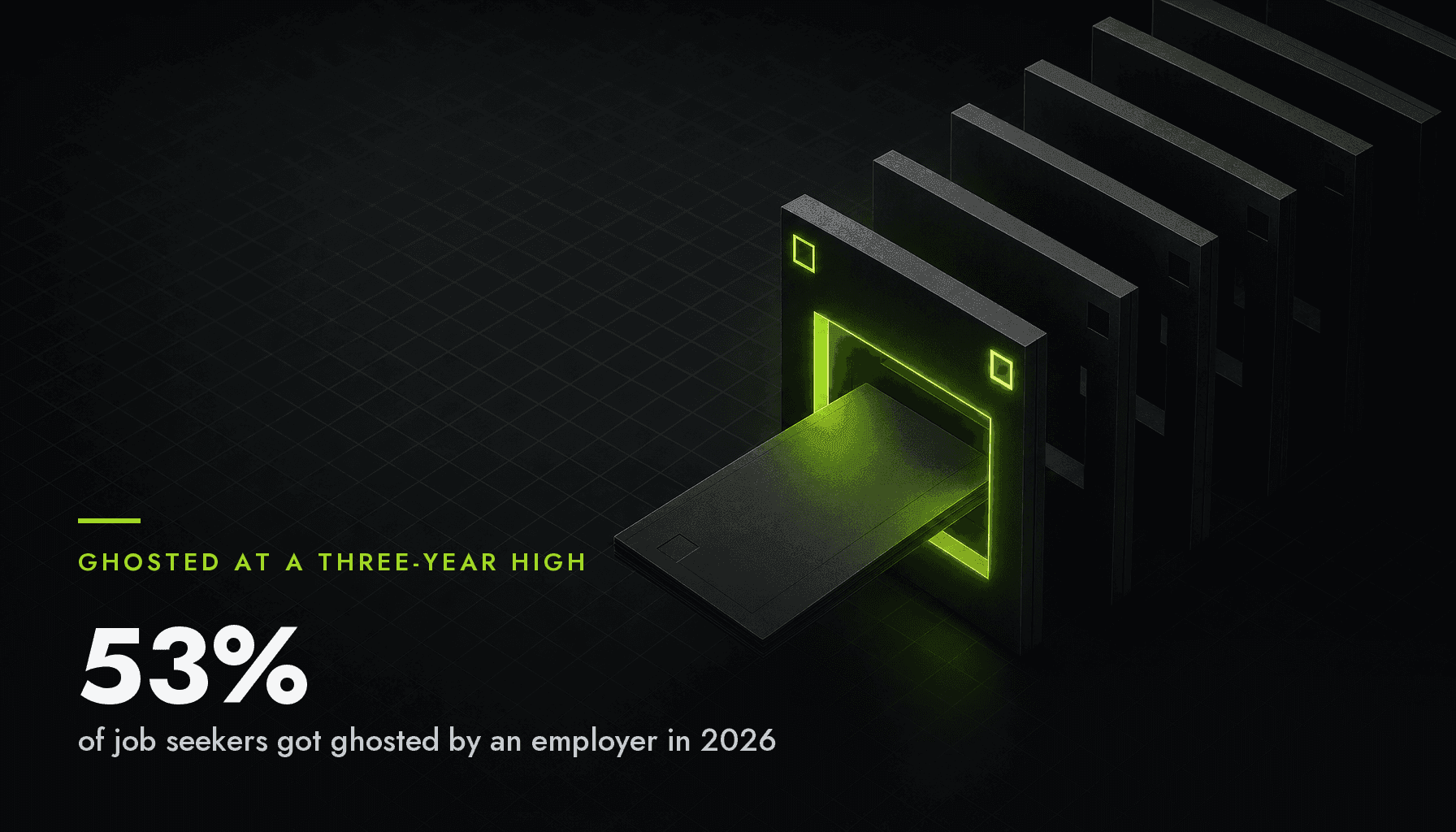
That's not a feeling. iHire's 2026 candidate experience survey of 1,024 job seekers found 53% had been ghosted by an employer in the past year, up from 48% in 2025 and 38% in 2024, a three-year high (corroborated by Fortune). The most common point it happens isn't after an interview. It's the earliest one: 28% of ghosting happens right after submitting the application, before any phone screen or human contact at all.
Something is deciding not to reply to you before anyone reads your name. The question worth answering isn't "is AI taking my job application seriously." It's what that something actually is.
Ghosting hit a three-year high in 2026
The 75% myth, and what's real instead
The stat everyone's heard is that 75% of resumes get auto-rejected by an ATS before a human ever sees them. It traces back to a defunct 2013 startup's marketing claim, not a study. There's no solid research behind that exact number, and the "robot silently trashes your resume" mental model is mostly wrong.
A 2025 study across 25 recruiters on 10+ ATS platforms found 92% don't configure any auto-reject rule based on resume content. Most systems rank and sort. They don't quietly delete.
What's real, and better documented, is less dramatic and more useful to know:
- 99% of large US employers use an ATS. Harvard Business School and Accenture's "Hidden Workers" research (Joseph Fuller, surveying 8,720 workers and 2,275 executives across the US, UK, and Germany) found ATS use near-universal at Fortune-500-class companies.
- About half of those employers auto-exclude a resume with a 6-month-plus employment gap, regardless of what's in it otherwise. That's a configured rule, not an AI judgment call.
- ~27 million "hidden workers" in that research were screened out by these systems despite being qualified, not on skill, but on structure.
- SHRM's 2026 State of AI in HR report (1,722 US HR professionals) found 39% of organizations now use AI somewhere in HR, 27% specifically in recruiting, and adoption splits hard by company size: 60% at 5,000+ employees versus 33-35% under 500.
This is already an agent's job, not just a form
The screening step itself is moving from "run a filter" to "run an agent." Clero, an AI-agent platform, publishes a candidate-screening workflow as one of its production automation cases: it ingests inbound applications, scores each resume against the role's stated criteria, routes the high-match ones to a hiring manager, and auto-drafts the rejection for everyone else.
That's not a hypothetical. It's a documented, running example of what "someone reviewed your application" increasingly means on the other end: a scoring pass against criteria, then a routed decision, with a human only in the loop for the applications that already cleared the bar.
What actually gets you filtered
Given all that, the real predictor of getting through isn't dodging keyword-stuffing tricks. It's alignment.
A vendor study (ResumeAdapter, 10,000 resume scans in Q1 2026, their own data, worth reading as directional rather than independent) found 71.4% of resumes scored below 75 out of 100 against their target job description. The biggest single cause of parsing failure wasn't content. It was formatting: tables, multi-column layouts, and graphics caused 23% of scoring failures on their own, because the parser never correctly reads what's inside them.
“A resume that's structurally sound and written in the job posting's own language scores dramatically better than a generic one, independent of how good the candidate actually is.”
Applying wide without burning a week on it
Once you accept that criteria-matching is happening at volume on the employer side, the sane response on your side is volume too, just not the manual kind.
That's what Autopilot is for. Remotera's extension fills applications from one profile across ATS forms, and by default every filled application stops for you to review before anything sends, screenshot and all. If you want more hands-off, you can opt into letting it auto-submit on its own, but only once a checklist of safety conditions clears first: known ATS, every field confidently resolved, no captcha, resume attached, no gap in your profile it had to guess at. If you want it fully hands-off, that's a separate choice you make explicitly. Nothing skips ahead of what you've told it to do.
The point isn't "apply to everything." It's that the 40th identical form is what burns people out of applying to roles they'd actually get, and removing that friction is the whole value.
The other half: a resume that isn't generic 40 times
Autopilot solves the retyping problem. It doesn't yet solve the alignment problem from above, because right now it fills the same profile into every form.
Per-job resume tailoring, rewriting emphasis and ordering to match each posting's language, is in active development, not shipped. When it lands, it's aimed directly at the JD-alignment gap: the same underlying profile, reworded and reordered per posting instead of pasted in flat. Worth knowing it's coming. Not worth assuming it's live yet.
What to actually do this week
- Rewrite your resume in a single column, no tables, no embedded graphics. That's the highest-leverage fix and it costs nothing.
- Match the posting's own words for your skills and title, not your internal job title from three roles ago.
- Don't leave an unexplained 6-month-plus gap sitting there if you can frame it in one line. Roughly half the employers screening you have a rule that flags it outright.
- Treat generic-blast applications as the low-ROI move now, not the safe one. A resume tuned to the specific posting beats volume of identical copies.