AI automates the code it can check
AI automates what it can verify — and that line runs through every engineering specialty, not between them. The boilerplate gets eaten; the judgment gets a raise. Here's what the hiring data actually shows.
Every "AI is coming for X" take names a specialization. Frontend first, because it's "just" UI. Then junior devs, then QA, then anyone who writes CRUD. Pick a job title, predict its funeral.
The data doesn't move by job title. Look at where AI actually writes the most code: frontend. JavaScript, TypeScript, HTML, and CSS make up 59% of the coding conversations in Anthropic's study of 500,000 of them — Python 14%, SQL 6%. If "the AI writes it" meant "the job dies," frontend engineers would be first in the ground. They're not.
So the specialization frame is broken. What predicts whether AI eats your work isn't what you build. It's whether the result can be checked.
| Label | Value |
|---|---|
| JS / TS / HTML / CSS | 59% |
| Python | 14% |
| SQL | 6% |
| Other languages | 21% |
500K coding conversations analyzed. Anthropic Economic Index.
The rule that actually predicts it
Andrej Karpathy put it in one line: traditional software automates what you can specify; AI automates what you can verify. You don't hand the model the steps. You check its output and keep the version that passes.
That makes verifiability the risk line. Work with a fast, automatic pass/fail — does it compile, does it render, does the test go green — is work AI can grind on cheaply, because it can try, check, and retry a hundred times a second. Work with no cheap oracle — will this schema hold at 50x traffic, is this the real cause of the outage, will a screen reader make sense of this — AI can't self-grade, so it can't self-improve.
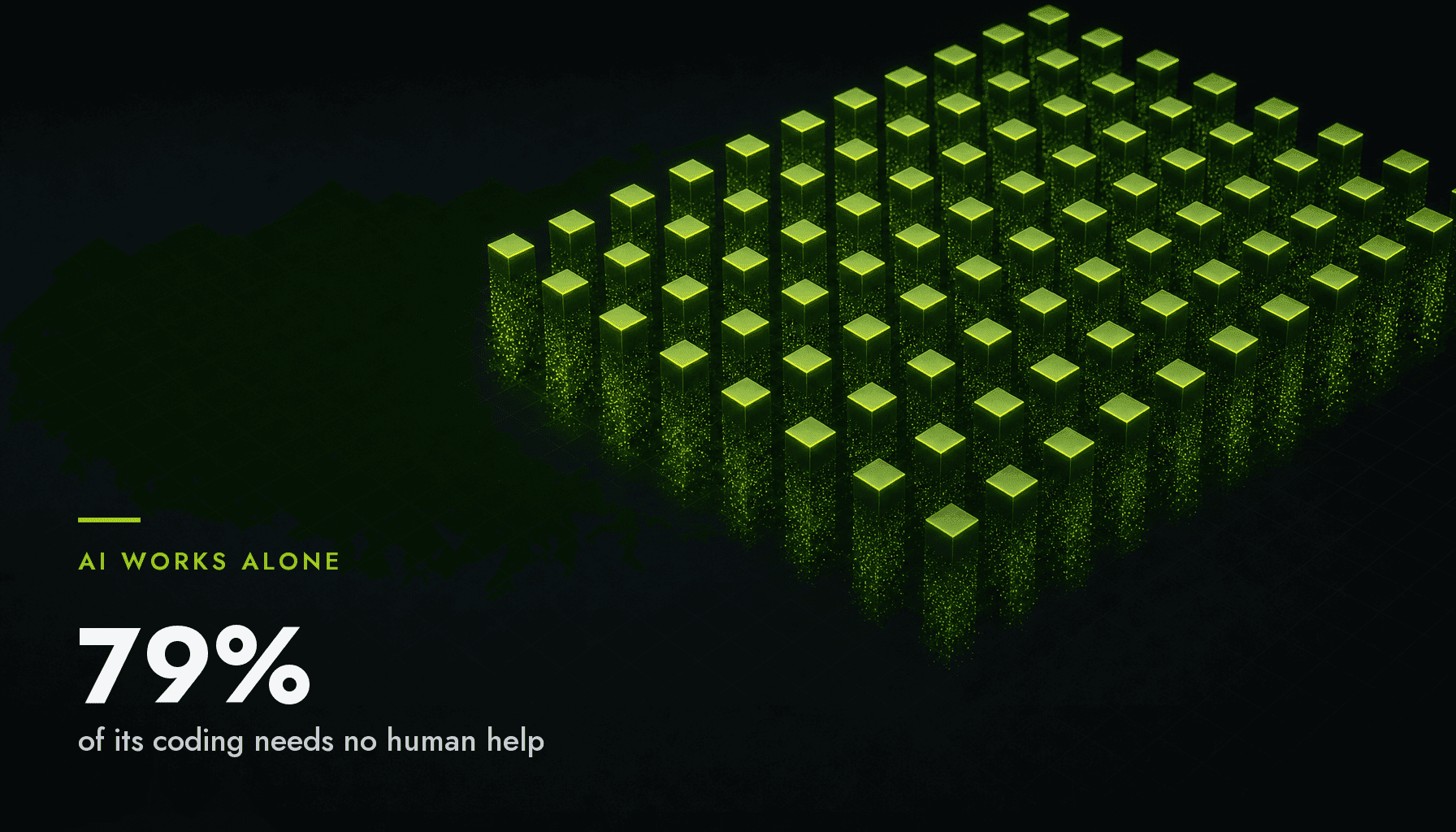
Anthropic's own numbers line up. On Claude Code, 79% of conversations are automation — the model doing the task outright — versus 49% on the general chat product. Automation clusters exactly where the feedback is instant: compile, render, run the test. Frontend leads the language chart not because AI is better at it, but because a browser returns a verdict on every keystroke. That's why it's first — and it's also why the panic misreads what "first" means.
“Traditional computers can easily automate what you can specify in code. LLMs can easily automate what you can verify.”
"Checkable" is a layer, not a job
Here's what the specialization takes miss: the checkable work and the judgment work live inside the same role. AI takes the checkable layer. What's left, in every specialty, is the judgment sitting on top.
Frontend is the cleanest example, because it's where AI writes the most and the split is most brutal. The model scaffolds the component, wires the state, matches the mock pixel for pixel. Then look at what has no pass/fail button. WebAIM's 2026 audit of the top million homepages found 95.9% fail basic accessibility checks, at 56.1 errors per page — both up from last year, as pages got more complex and more machine-generated. The pixels render. The accessibility, the cross-browser edge cases, the "why does this re-render 40 times" — no oracle, no automation, still yours.
Same cut, every specialty:
- Backend — AI writes the CRUD endpoint and the migration. Whether the schema survives real traffic, and which caching strategy won't corrupt state, has no green checkmark.
- DevOps / platform — routine Terraform and threshold tuning are checkable, and going. Reading an incident at 3am and knowing which dashboard is lying is not.
- Data / ML — the glue code is generated. The models still hang on company-specific, undocumented business logic, the least checkable thing in the building.
- QA — writing the assertion is trivial and automatable. Knowing which test actually matters for this system is the judgment that doesn't.
The market already repriced it — upward, not out
If AI were killing engineers, postings would fall with the rest of the market. They're doing the opposite. Indeed's Hiring Lab found US software-development postings up almost 15% since Claude Code launched in early 2025, while total postings fell 7% — the divergence in the chart below. The catch is where the growth went: 71% of it is senior roles, and 37% of the new postings name AI in the title. The junior, checkable rung thinned. The senior, judgment rung grew.
- Software development
- IT operations & helpdesk
- Total US postings
| Category | Software development | IT operations & helpdesk | Total US postings |
|---|---|---|---|
| Feb 2020 | 100 | 100 | 100 |
| Mar 2020 | 100.1 | 96.8 | 100 |
| Apr 2020 | 86.8 | 82.3 | 78.9 |
| May 2020 | 70.3 | 67.5 | 62.3 |
| Jun 2020 | 64.8 | 66.6 | 65.4 |
| Jul 2020 | 65.4 | 69.5 | 74.4 |
| Aug 2020 | 69.1 | 74.6 | 82.3 |
| Sep 2020 | 71 | 75.2 | 84.1 |
| Oct 2020 | 75 | 80.2 | 88.7 |
| Nov 2020 | 80.8 | 80.5 | 91.9 |
| Dec 2020 | 87.9 | 82.3 | 94.2 |
| Jan 2021 | 91.3 | 84.3 | 95.3 |
| Feb 2021 | 98 | 86.2 | 100.3 |
| Mar 2021 | 107.9 | 91.9 | 105.9 |
| Apr 2021 | 116.9 | 99.5 | 117.1 |
| May 2021 | 125.7 | 106.2 | 126.3 |
| Jun 2021 | 134 | 113.5 | 131.4 |
| Jul 2021 | 141.2 | 118.9 | 136.6 |
| Aug 2021 | 151.1 | 125.8 | 136.7 |
| Sep 2021 | 169.8 | 133.7 | 141.6 |
| Oct 2021 | 179 | 141.1 | 144.8 |
| Nov 2021 | 193.8 | 145.4 | 149.4 |
| Dec 2021 | 209.9 | 148.3 | 154.8 |
| Jan 2022 | 213 | 150.8 | 157.3 |
| Feb 2022 | 225.2 | 153.6 | 157.5 |
| Mar 2022 | 233.6 | 155.4 | 160.4 |
| Apr 2022 | 225.6 | 157.3 | 161.1 |
| May 2022 | 223.5 | 157.6 | 160.3 |
| Jun 2022 | 224.9 | 159.6 | 160.1 |
| Jul 2022 | 211.3 | 157.9 | 157.3 |
| Aug 2022 | 194.2 | 151.9 | 154.7 |
| Sep 2022 | 180.4 | 148.4 | 152 |
| Oct 2022 | 168.1 | 143.1 | 149.4 |
| Nov 2022 | 155.1 | 137.1 | 147.7 |
| Dec 2022 | 142.3 | 131.2 | 146.5 |
| Jan 2023 | 130.3 | 126 | 142.6 |
| Feb 2023 | 121.2 | 119.3 | 139.2 |
| Mar 2023 | 106 | 111 | 134.2 |
| Apr 2023 | 99.5 | 110.9 | 135.6 |
| May 2023 | 98.2 | 110.8 | 136.2 |
| Jun 2023 | 94 | 103.7 | 133.7 |
| Jul 2023 | 82.6 | 98.6 | 130.2 |
| Aug 2023 | 81.5 | 96.6 | 129.4 |
| Sep 2023 | 78.7 | 95.1 | 127.7 |
| Oct 2023 | 75.1 | 91.2 | 125.6 |
| Nov 2023 | 74.2 | 88.1 | 124.4 |
| Dec 2023 | 72.6 | 85.4 | 121.9 |
| Jan 2024 | 72.7 | 84.8 | 120.4 |
| Feb 2024 | 71.2 | 84.3 | 118.2 |
| Mar 2024 | 70.9 | 82.8 | 118 |
| Apr 2024 | 70.8 | 82.3 | 119 |
| May 2024 | 69.2 | 80.8 | 117.3 |
| Jun 2024 | 70.2 | 79.5 | 114.8 |
| Jul 2024 | 70.1 | 79.5 | 113.4 |
| Aug 2024 | 69.8 | 78.3 | 114.3 |
| Sep 2024 | 68.6 | 79 | 112.4 |
| Oct 2024 | 69.2 | 77.5 | 112.3 |
| Nov 2024 | 68.6 | 75.4 | 108.6 |
| Dec 2024 | 67.5 | 73.5 | 110.3 |
| Jan 2025 | 67.5 | 72.6 | 110.7 |
| Feb 2025 | 66.8 | 72.8 | 109.5 |
| Mar 2025 | 62.6 | 70.8 | 108.8 |
| Apr 2025 | 62.6 | 71 | 106.8 |
| May 2025 | 63.2 | 68.3 | 105.9 |
| Jun 2025 | 64.1 | 68.9 | 105.5 |
| Jul 2025 | 65.4 | 67.7 | 104.8 |
| Aug 2025 | 66.2 | — | 104.8 |
| Sep 2025 | 65.1 | — | 103.9 |
| Oct 2025 | 64.3 | — | 101.3 |
| Nov 2025 | 65.8 | — | 100.4 |
| Dec 2025 | 66.7 | — | 102.2 |
| Jan 2026 | 67.2 | — | 103.1 |
| Feb 2026 | 69.4 | — | 103.6 |
| Mar 2026 | 70.7 | — | 105.4 |
| Apr 2026 | 72.8 | — | 102.2 |
| May 2026 | 73 | — | 102.5 |
| Jun 2026 | 73.4 | — | 100.1 |
| Jul 2026 | 73.5 | — | 101 |
Seasonally-adjusted, monthly. Indeed Hiring Lab via FRED (IHLIDXUSTPSOFTDEVE, IHLIDXUSTPITOPHE, IHLIDXUS). IT operations & helpdesk series ends Jul 2025.
SignalFire's 2026 report says the same from the employer side. Across twelve of the biggest tech companies, total hiring is down 25% from 2019, but engineering hiring is down only 11% — and engineers went from 46% of new hires to 55%. Companies cut the org and kept the judgment layer.
None of this is a return to the old normal; software development postings are still about 27.5% below pre-pandemic. It's a reshape. The work that survived is the work with no pass/fail button, and it's clustered at the senior end.
Engineers as a share of new hires at 12 major tech companies
What that means if you're the one job-hunting
Remote skews the same way, if not harder — the roles that clear a remote bar tend to be the ones employers trust to run without a babysitter, which is judgment work by definition. So for a remote engineer deciding where to point the next two years, the read is the same as the market's:
- Sell judgment, not stack. "React, Node, Postgres" is a list of things AI also knows. "I cut our p95 by 60% and can tell you which query did it" is not. Lead with the calls you've made, not the tools you've held.
- Treat AI fluency as table stakes. With 37% of new software postings naming AI, it's a filter now, not a differentiator. Expected if you have it, disqualifying if you don't.
- Aim above the checkable rung. The thin part of the market is exactly the part AI does best. If you're early-career, get to judgment work fast — on anything with real consequences — instead of racing a model on scaffolding speed.
The old question, "is my specialization safe from AI?", has no useful answer. The one that does: how much of my day survives without a pass/fail button? Whatever's left is the job now, and it's the part that's hiring.